

Automate code review comments
Time to write this rule: 5 minutes You can use Semgrep and its GitHub integration to automate PR comments that you frequently make in code reviews. Writing a custom rule for the code pattern you want to target is usually straightforward. If you want to understand the Semgrep syntax, see the documentation or try the tutorial.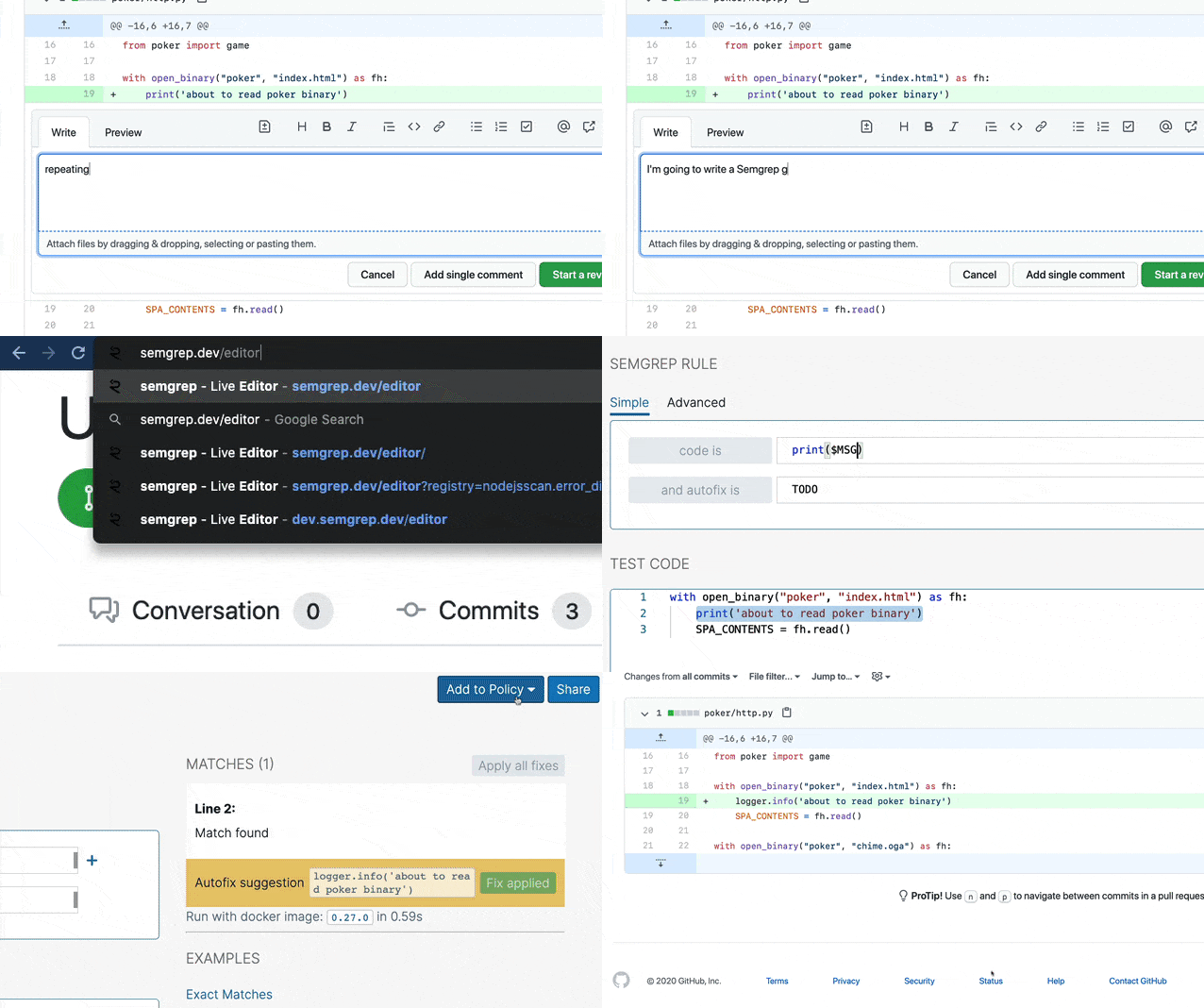
Ban dangerous APIs
Time to write this rule: 5 minutes Semgrep can detect dangerous APIs in code. If integrated into CI/CD pipelines, you can use Semgrep to block merges or flag for review when someone adds such dangerous APIs to the code. For example, a rule that detects React’sdangerouslySetInnerHTML looks like this.
Exempt special cases of dangerous APIs
Time to write this rule: 5 minutes If you have a legitimate use case for a dangerous API, you can exempt a specific use of the API using anosemgrep comment. The rule below checks for React’s dangerouslySetInnerHTML, but the code is annotated with a nosemgrep comment. Semgrep will not detect this line. This allows Semgrep to continuously check for future uses of dangerouslySetInnerHTML while allowing for this specific use.
Detect tainted data flowing into a dangerous sink
Time to write this rule: 5 minutes Semgrep’s dataflow engine with support for taint tracking can be used to detect when data flows from a user-provided value into a security-sensitive function. This rule detects when a user of the ExpressJS framework passes user data into therun() method of a sandbox.
Detect security violations
Time to write this rule: 5 minutes Use Semgrep to flag specific uses of APIs too, not just their presence in code. We jokingly call these the “security off” buttons and make extensive use of Semgrep to detect them. This rule detects when HTML auto-escaping is explicitly disabled for a Django template.Scan configuration files using JSON, YAML, or generic pattern matching
Time to write this rule: 10 minutes Semgrep natively supports JSON and YAML and can be used to write rules for configuration files. This rule checks for skipped TLS verification in Kubernetes clusters.Enforce authentication patterns
Time to write this rule: 15 minutes If a project has a “correct” way of doing authentication, Semgrep can be used to enforce this so that authentication mishaps do not happen. In the example below, this Flask app requires an authentication decorator on all routes. The rule detects routes that are missing authentication decorators. If deployed in CI/CD pipelines, Semgrep can block undecorated routes or flag a security member for further investigation.Systematize project-specific coding patterns
Time to write this rule: 10 minutes Automate institutional knowledge using Semgrep. This has several benefits, including teaching new members about coding patterns in an automatic way and keeping a project up-to-date with coding patterns. If you keep coding guidelines in a document, converting these into Semgrep rules is a great way to free developers from having to remember all the guidelines. In this example, a legacy API requires callingverify_transaction(t) before calling make_transaction(t). The Semgrep rule below detects when these methods are not called correctly.
Extract information with metavariables
Time to write this rule: 15 minutes Semgrep metavariables can be used as output in themessage key. This can be used to extract and collate information about a codebase. Click through to this example, which extracts Java Spring routes. This can be used to quickly see all the exposed routes of an application.
Detect deprecated APIs
Time to write this rule: 5 minutes Semgrep can detect deprecated APIs just as easily as dangerous APIs. Identifying deprecated API calls can help an application migrate to current or future versions. This rule example detects a function that is deprecated as of Django 4.0.Promote secure alternatives
Time to write this rule: 5 minutes Some libraries or APIs have safe alternatives, such as Google’sre2, an implementation of the standard re interface that ships with Python that is resistant to regular expression denial-of-service. This rule detects the use of re and recommends re2 as a safe alternative with the same interface.
Prompts for writing custom rules
Try answering these questions to uncover important rules for your project.- From recent post-mortems: what code issues contributed to it?
- [XYZ] is a (security, performance, other) library that everyone should use, but they don’t consistently.
- When you review code, what changes do you frequently ask for?
- What vulnerability classes from bug bounty submissions recur (or appear in different places of the codebase)?
- Are there engineering or performance patterns? Consistent exception handlers?
- What issues were caused by misconfigurations in Infrastructure-as-Code files (JSON)?
- What are some “invariants” that should hold about your code - things that should always or never be true (for example, every admin route checks if the user is an admin)?
- What methods/APIs are deprecated and you’re trying to move away from?