To add a repository, you must install the public Semgrep GitHub app and create and install a private Semgrep GitHub App.
The public Semgrep GitHub app is required to easily add members of your GitHub org to your Semgrep org.
The private Semgrep GitHub app is required to enable code access for Managed Scans.
If you have not completed the installation of public and private Semgrep GitHub apps, Semgrep prompts you to do so when adding a repository.See SCM permissions for more information about the permissions used by Semgrep.
If you have not completed the installation of public and private Semgrep GitHub apps, you are redirected to the Set up Managed Scans page, which facilitates the creation of both.
i. Follow the steps in the page to create and register both a public and private Semgrep GitHub app.
4
In the Enable Managed Scans for repos page, select the repositories you want to add to Semgrep Managed Scans.
i. Optional: If you do not see the repository you want to add, click Can’t find your project? and follow the troubleshooting steps provided.
5
Select the repositories you want to scan from the list.
6
Click Enable Managed Scans. The Enable Managed Scans dialog appears. By default, Semgrep runs both full and diff-aware scans.
7
Optional: Disable PR or MR diff-aware scans by turning off the Enable PR/MR scans toggle.
You have finished setting up a Semgrep managed scan.
After enabling Managed Scans, Semgrep performs a full scan in batches on all the repositories.
Once a repository has been added to Semgrep AppSec Platform, it becomes a project. A project in Semgrep AppSec Platform includes all the findings, history, and scan metadata of that repository.
Projects with a Managed Scan configuration are tagged with managed-scan, regardless of whether the project is actively being scanned by Semgrep Managed Scans or not. The Projects list also contains pending scans and scans that never started.
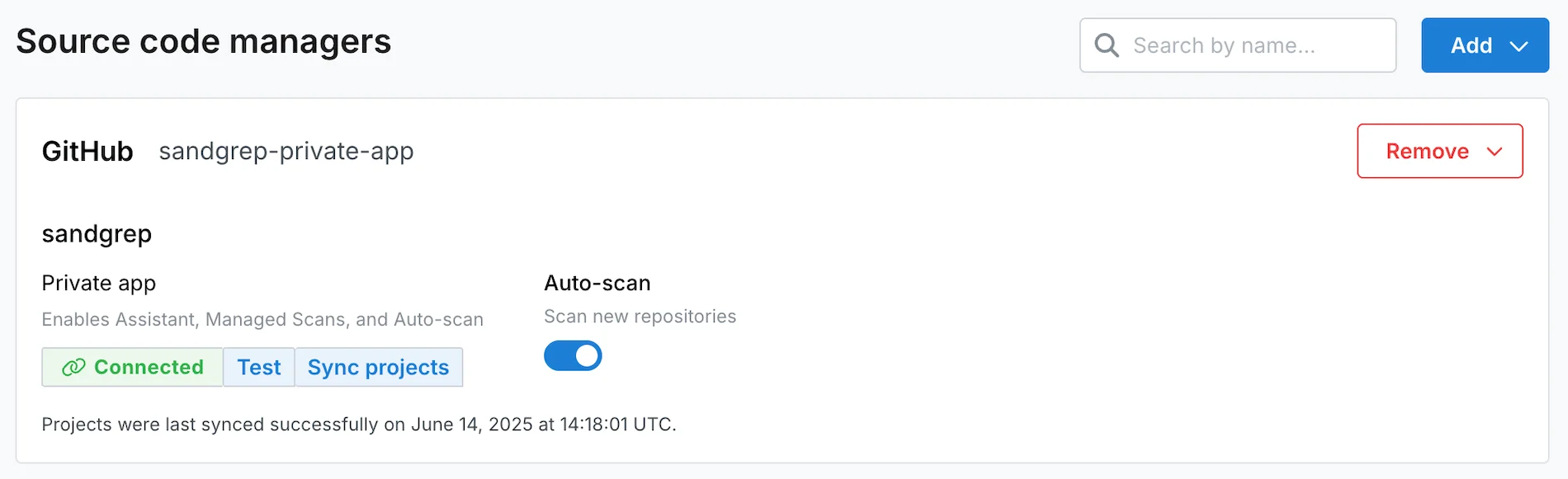
A complete installation is displayed in the Source Code Manager entry as follows:
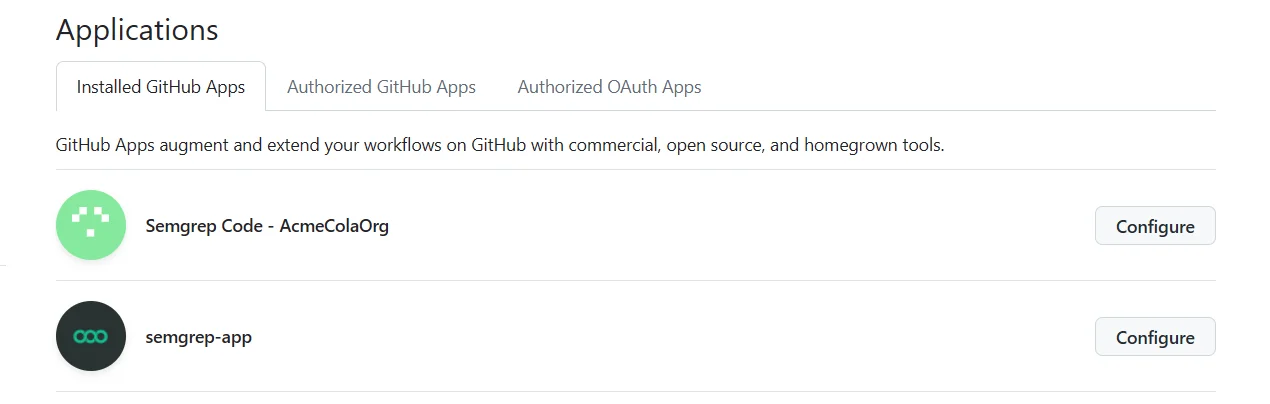
Figure. Semgrep AppSec Platform > Settings > Source Code Managers displaying a completed Managed Scans set-up.You can also confirm a complete installation through your GitHub settings page, which should have two Semgrep apps:
Figure. GitHub > Settings > Applications displaying both Semgrep apps. The private Semgrep app follows the convention Semgrep Code - YOUR_ORG_NAME.
Ensure you have provided access to both the private and public Semgrep GitHub apps to the repositories you want to scan by following the steps in Permissions and synchronicity.
2
In Semgrep AppSec Platform, click Projects.
3
If the page does not display the repository you want to add, click Can’t find your project? > Sync projects.
4
If the page does not display any repositories, click Sync projects.
5
Optional: Perform a hard refresh (Ctrl+F5 or Cmd+Shift+R).
Repositories must be accessible to both the public Semgrep GitHub app and the private Semgrep GitHub app.
Delete the /.github/workflows/semgrep.yml file in your GitHub repository if appropriate.
If you plan to continue running some scans in GitHub Actions (for example, using Managed Scans to run weekly full scans but GitHub Actions for diff-aware scans) you can leave the workflow file in place, and edit it to reflect your desired configuration.
TIPSemgrep preserves your findings, scans, and triage history.
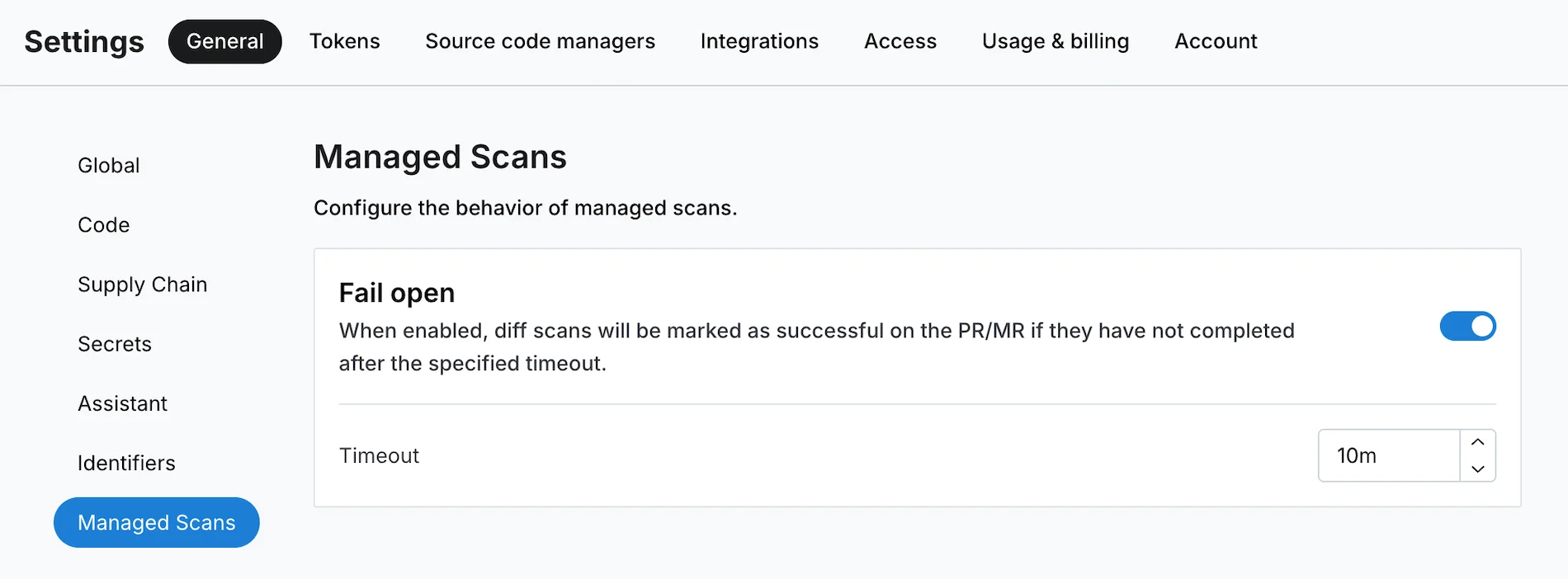
Configure fail open to prevent diff-aware scans from blocking pull requests and merge requests
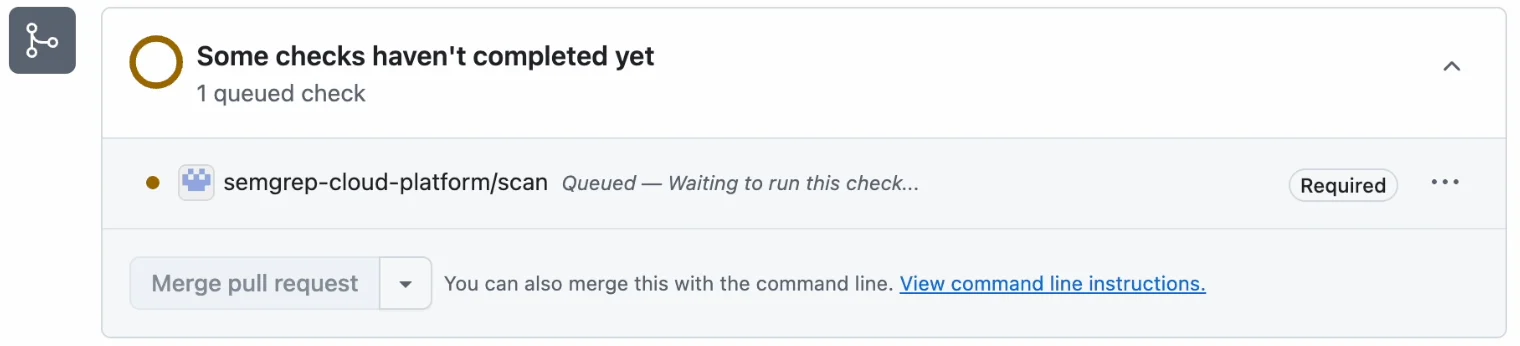
By default, diff-aware managed scans are set to fail open if a scan errors out or takes too long. This means that diff-aware scans are marked as successful on the pull request (PR) or merge request (MR), even if they have not completed after the specified timeout. This lets you make the Semgrep status check required in your source code manager (SCM) without blocking someone from merging a PR or MR if the check encounters an unexpected issue or takes too long.
Sample pull request showing the status of a diff-aware scan.
If enabled, the fail open feature is triggered whenever you open a PR or MR.
2
Initially, Semgrep sends an update to mark the PR or MR as pending.
3
Once the diff-aware scan begins, the PR or MR is updated to a status of running.
4
The diff-aware scan completes, and the PR or MR is updated to a status of succeeded or failed.
5
If the diff-aware scan is in pending or running status longer than the configured timeout, then the fail open process updates the PR or MR to display a status of succeeded. This prevents the Semgrep scan from blocking the developer from merging their changes.
If Semgrep marks a PR or MR as succeeded, you can merge the PR or MR without waiting for the diff-aware scan to complete. However, if the PR or MR is still open and the scan completes after the fail open timeout is reached, Semgrep can still report the findings and mark the status as failed.
Turn off Managed Scans for specific repositories in Semgrep AppSec Platform
1
Sign in to Semgrep AppSec Platform.
2
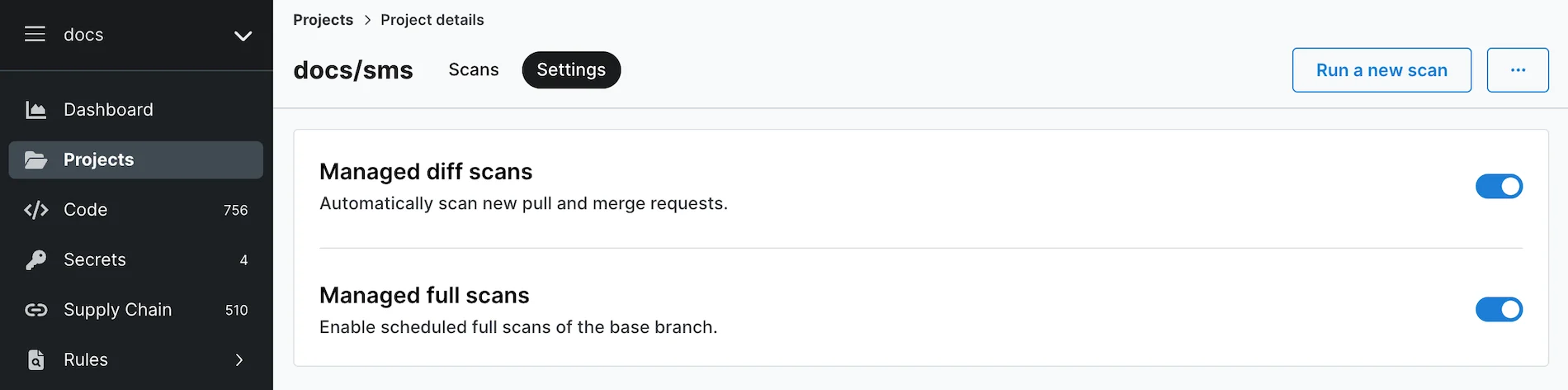
Go to Projects and find the project you no longer want scanned with Semgrep Managed Scanning. Click the project’s Details page > Settings tab.
3
Toggle the switch for Managed diff scans to turn off scans of new pull requests and merge requests and Managed full scans to turn off full scans of the base branch.
WARNINGIf your source code manager has Auto-scan enabled so that Semgrep automatically scans new repositories, turn off Managed Scans for specific repositories using Semgrep AppSec Platform. Do not turn off Managed Scans by deleting the repository from Semgrep AppSec Platform. If you have Auto-scan enabled and you delete your repository from the platform, Semgrep re-syncs the repository you deleted.
Both the public and private Semgrep GitHub app must have access to the repositories you want to scan.To view the repositories you have granted access to:
To view your scan logs in Semgrep AppSec Platform, go to Projects, then click on the project name. The projects in the list are sorted by scan date, with the most recent scans listed first.
INFOIt can take a few minutes for your latest scan logs to appear. However, if the logs do not update 15 minutes after the scan, there may be issues with the scan itself.
Scan statistics, such as how many of your repositories are being scanned, the scan success rate, and so on, can be provided once a week upon request. Contact your Semgrep account manager to request scan statistics.